
AI agent memory that remembers the
reasons — and catches itself
contradicting.
Ergo is a memory backend for AI coding agents that stores every decision alongside why it was made — with kill-criteria, conflict detection, and full revision history. It scales from a single agent's local store to a multi-tenant engine — one isolated SQLite silo per team — so one org's decisions can never leak into another's. Stop losing context across sessions.
Everything Ergo does, in one place
Six capabilities, one continuous scroll. Keep going to see each one in action — the panel keeps up.
Store a decision with its reason
--because isn't optional metadata, it's what makes the claim retrievable and checkable later.Four stages stand between a claim and storage
Recall the reason nobody remembers
Stale beliefs flag themselves
Isolated by tenant, not by convention
org_id column. A dropped filter can't leak claims across tenants, because the rows aren't even in the same database. Tokens are per-principal and hashed at rest; org_id and who resolve from the token server-side, never self-asserted from the request.two tenants, two physically separate SQLite files
A drop-in MCP memory server
Store a decision with its reason
--because isn't optional metadata, it's what makes the claim retrievable and checkable later.Four stages stand between a claim and storage
Recall the reason nobody remembers
Stale beliefs flag themselves
Isolated by tenant, not by convention
org_id column. A dropped filter can't leak claims across tenants, because the rows aren't even in the same database. Tokens are per-principal and hashed at rest; org_id and who resolve from the token server-side, never self-asserted from the request.A drop-in MCP memory server
How Ergo compares
By category, not by name — each class of tool is genuinely good at what it's built for, and the honest answer is that Ergo is complementary: keep your recall layer, add judgment for the decisions that must not silently flip.
| Capability | Ergo | General-purpose memory layers | Vector databases |
|---|---|---|---|
| Semantic recall | ✓ | ✓ | ✓their core strength |
| Broad context capture (chat history, sessions, entities) | —narrow by design | ✓their core strength | partial |
| Write-time contradiction guard | ✓hard conflict returns the prior claim and its reason | — | — |
| A reason attached to every decision, queryable via "why" | ✓ | partialfree-form metadata | — |
| Supersede / retract ledger that preserves why a decision changed | ✓ | partialupdate/delete without the why-chain | — |
| Hard per-team isolation | ✓one isolated store per org | varies | variesusually shared index + namespaces |
| Single-container offline self-host | ✓models baked in, boots with no network | varies | varies |
| Billions-scale vector search | —deliberately not | varies | ✓their core strength |
Contradiction-guard numbers are measured, not asserted: precision 0.80–0.86 / recall 0.81, zero false hard-blocks on a labeled real-prose benchmark — see Why Ergo for the methodology.
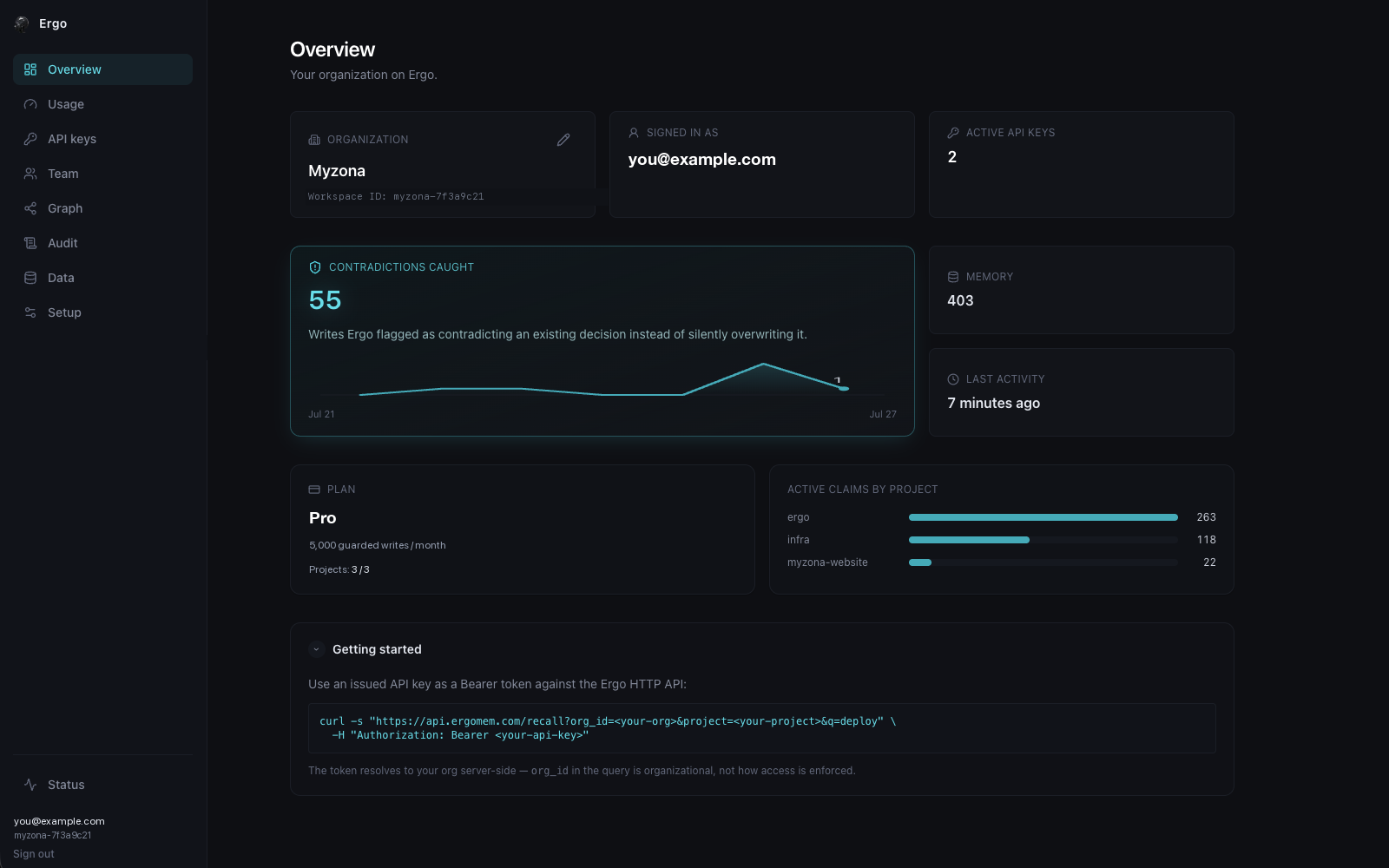
A real dashboard, not a black box
Plan usage, memories per project, and contradictions caught — the hosted panel that comes with every account, not just an API.
Frequently asked questions
Common questions about Ergo — AI agent memory, how it compares, and how it runs.
What is Ergo?
Ergo is a memory backend for AI coding agents. It stores every decision alongside the reason behind it, and checks each new claim against what's already stored — catching contradictions at write time instead of letting stale memory silently poison future decisions.
Which AI agents does Ergo work with?
Any agent that speaks the Model Context Protocol (MCP). Claude Code and Opencode use it today, and Ergo runs as a drop-in MCP memory server scoped per repo and per agent, so anything MCP-compatible can share the same memory.
How is Ergo different from a vector database like Pinecone or Chroma?
A vector database gives an agent recall but no judgment: when a decision changes, the old claim stays embedded and retrievable, so a contradiction is treated as just another similar document. Ergo adds a write-time judgment layer — it normalizes, structurally compares, and runs a natural-language-inference check before storing, returning HTTP 409 with the conflicting claim so the agent has to resolve it. It also keeps the reason behind every decision and a full supersede history.
How does Ergo compare to other AI agent memory tools like mem0 or Zep?
Tools like mem0 and Zep are general-purpose agent-memory layers focused on capturing and recalling context. Ergo is narrower and complementary: it is built around a write-time contradiction guard and a reason attached to every decision, aimed at high-stakes, slow-changing choices like conventions, configs, and architecture. See the side-by-side comparison.
Can I self-host Ergo?
Ergo is built to be self-hosted — a single Docker container plus one SQLite file, no external services, running fully offline and air-gapped. It is in active development and currently used in production by the coding agents building it; a hosted team server is on the way.
How accurate is Ergo's contradiction detection?
On 105 labeled real-world prose pairs, Ergo's judge runs at roughly 0.80–0.86 precision and about 0.81 recall with zero false hard-blocks, and the engine ships with 500+ offline tests. It normalizes claims first, compares structure, then applies NLI only to the fuzzy residual behind an overlap gate — which beats retrieval or NLI alone.